
Minum Barreng and the evolution of ‘Clean Faces, Strong Eyes’ to ‘Milpa’s Six Steps to Stop Germs’ for the sustainable elimination of trachoma in Australia
Minum Barreng and the evolution of ‘Clean Faces, Strong Eyes’ to ‘Milpa’s Six Steps to Stop Germs’ for the sustainable elimination of trachoma in Australia
“Milpa is like a rock star, and when you arrive in an Australian remote Aboriginal community in the Milpa car, the kids rush over to ask where is Milpa? Is Milpa coming? After more than 16 years of trachoma elimination health promotion, Milpa is highly recognised and welcomed in community - he is the essence of the campaign. The Milpa image and the tag line ‘Clean Faces, Strong Eyes’ has been repeated and reinforced regularly for over half a generation in posters, murals, school lessons, on social media and in community service announcements on TV and radio.”
– Lesley Martin, Arrernte woman and Trachoma Community Engagement Officer, Mparntwe (Alice Springs) Northern Territory (August 2026)
In 2026, Australia was validated by the World Health Organization as having eliminated trachoma as a public health problem. Until then, it was the only high-income country still known to require interventions against the disease. While trachoma had largely disappeared from the general Australian population during the early 20th century following major improvements in living conditions, access to clean water and sanitation, national surveys in the 1970s revealed that the disease remained endemic in a number of remote Aboriginal and Torres Strait Islander communities and regions.
Although significant progress was made over subsequent decades, transmission persisted in geographically isolated communities across central, northern and western Australia. Persistent inequities in access to healthcare, safe and functional housing, clean water and sanitation created conditions that allowed trachoma to endure. Eliminating the disease required not only the delivery of clinical interventions, but also sustained community engagement to promote facial cleanliness and healthy hygiene behaviours.
Against this backdrop, Minum Barreng (also known as Minum Barreng: Indigenous Eye Health Unit at The University of Melbourne) reviewed the trachoma health promotion resources then available in 2009, most of which had been developed for use in African countries. It was recognized that there was a need for materials designed specifically for Australian communities.
Working in partnership with the Katherine West Health Board's Ngumbin Reference Group and the Northern Territory Centre for Disease Control, Minum Barreng developed a suite of trachoma health promotion resources with input from remote Aboriginal communities. The clear message from the Ngumbin Reference Group was: "Tell it to us straight." Community members wanted to understand that trachoma could lead to blindness and, importantly, how it could be prevented.
Milpa the goanna was originally created in 2008 by graphic designer Lily McDonnell, who was commissioned by the Centre for Eye Research Australia (CERA) to design a character that would help children in the Northern Territory learn about healthy eyes and good vision. Milpa's name came later and is derived from the Warlpiri word for "eye".
The community-suggested message, "Clean Faces, Strong Eyes," became Milpa's signature slogan and featured across all campaign materials. Milpa has since become something of a local celebrity: strengths-based, culturally relevant, and carrying a message created by community for community. Milpa exists beyond printed materials as human size suits (currently there are 14 suits) allow Milpa to attend community events, festival days and celebrations and participate in videos and through photography. Children regularly recognise Milpa and enthusiastically call out, "Clean Faces, Strong Eyes!" before demonstrating the facial cleanliness actions they have learned. The campaign reinforces a simple, positive message: clean faces help keep eyes healthy and strong.
With additional funding support from philanthropy and government, the campaign expanded Milpa's reach through the production of music videos that incorporated local languages, stories and Country and community service announcements on radio and TV. Then enhanced community engagement and incorporation into educational curricula helped consolidate the messaging. In several communities, local artists worked alongside community members to design and paint striking murals featuring Milpa, clean faces and local cultural totems. Positioned in prominent community spaces, such as basketball courts where families gather for events or outside local stores visited daily, these murals serve as highly visible reminders of the campaign's key messages.
Another important factor in the campaign's success was ensuring that resources were freely available wherever they were needed. Australian Government support enabled the production, distribution and ongoing supply of materials across communities, allowing organisations to access them at no cost.
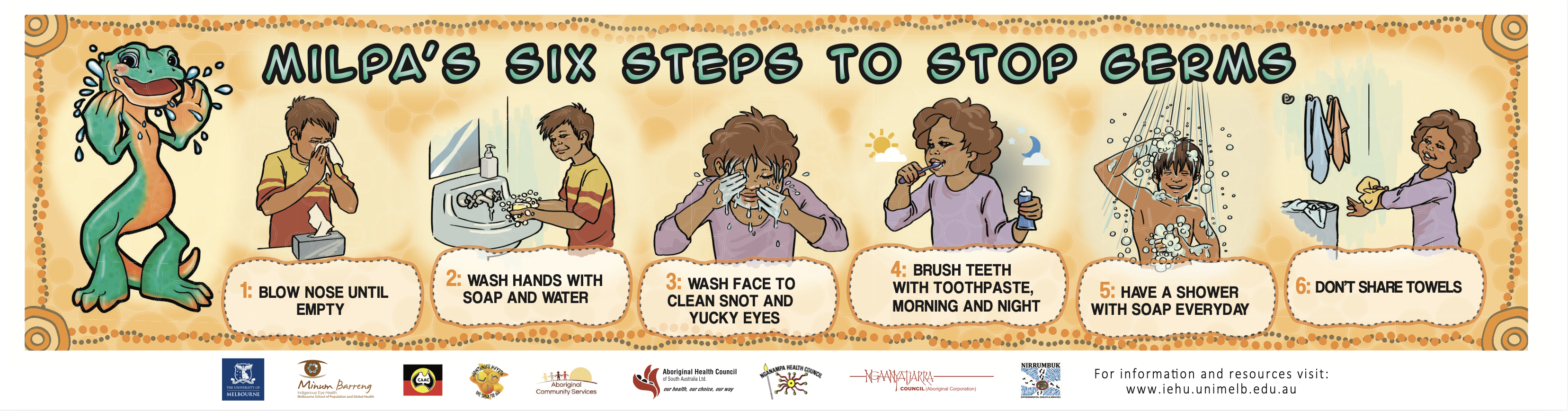
As trachoma prevalence continued to decline, attention turned to sustaining facial cleanliness behaviours over the long term. This led to Milpa's role expanding beyond trachoma to promote broader hygiene messages through "Milpa's Six Steps to Stop Germs." From 2019 onwards, the original "Clean Faces, Strong Eyes" message became part of a wider set of everyday healthy hygiene practices, including regular whole-body washing, cleaning teeth and ears, and not sharing towels. These behaviours help prevent trachoma while also reducing other common childhood infections and improving ear, skin and oral health.
The evolution of the campaign has been shaped through ongoing collaboration with community members, Aboriginal Community Controlled Health Services and other partners. Milpa has embraced this broader health promotion role while continuing to reinforce the behaviours that helped eliminate trachoma. As a result, the resources have remained practical, relevant and widely used, ensuring that both Milpa and the campaign's core messages continue to resonate with communities.
Australia's experience demonstrates that eliminating trachoma among Indigenous populations requires more than clinical interventions alone. Success depended on long-term partnerships with communities, culturally relevant health promotion, and sustained investment in addressing the underlying determinants of health. The Milpa campaign illustrates the value of community-led approaches that build on local languages, cultures and strengths rather than relying on externally developed messages. These lessons are relevant well beyond Australia. Indigenous peoples around the world continue to experience a disproportionate burden of many neglected tropical diseases and other preventable health conditions, often driven by inequitable access to healthcare, safe water, sanitation and housing. As countries work towards the elimination of trachoma as a public health problem, ensuring that Indigenous communities are meaningfully engaged in the design, delivery, leadership and ownership of programmes will be essential to reaching those most often left behind and sustaining elimination for future generations.
This case study is part of the International Coalition for Trachoma Control’s special series on special populations, published for International Day of the World’s Indigenous Peoples. It serves as a companion case study to the ICTC Special Populations toolkit.
Learn more about delivering trachoma interventions among Australia's Indigenous and Torres Strait Islander communities at the University of Melbourne.