
Global population requiring interventions against trachoma falls below 100 million for the first time
Geneva l London l Decatur
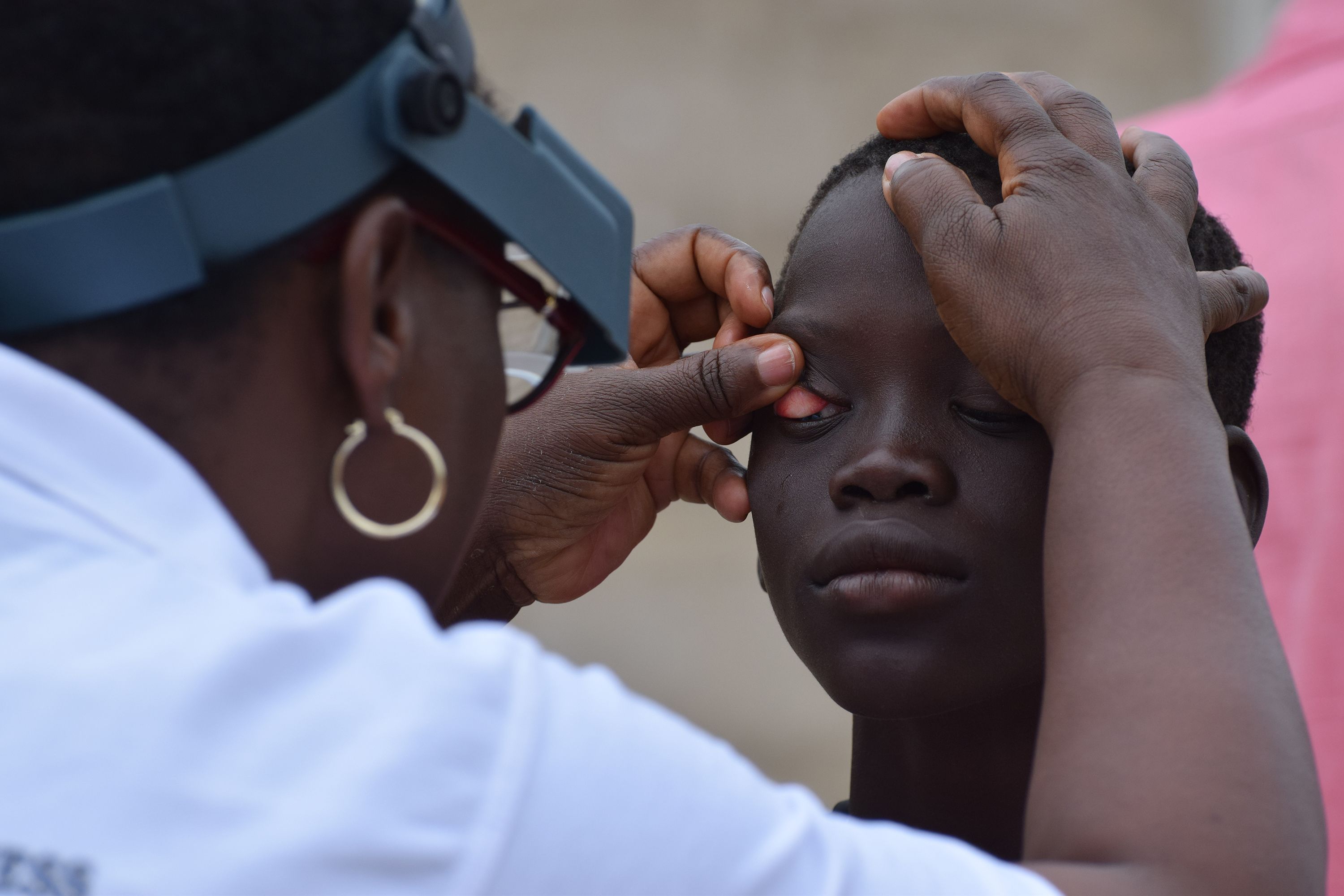
The number of people requiring interventions against trachoma, the world’s leading infectious cause of blindness, has fallen below 100 million for the first time since global records began. There were 1.5 billion people estimated to be at risk in 2002, dropping to 97.1 million as of November 2025: a 94% reduction (as recently as 2011, 314 million people were estimated to be at risk and therefore require interventions.)
This milestone reflects decades of sustained efforts by national health ministries, local communities, and international partners implementing the World Health Organization (WHO)-endorsed SAFE strategy (Surgery to treat trachomatous trichiasis, the blinding stage of trachoma; Antibiotics to clear infection; and Facial cleanliness and Environmental improvement to reduce transmission and sustain progress).
Progress across all trachoma-endemic WHO regions shows that SAFE is both effective and adaptable across contexts— Dr Daniel Ngamije Madandi, Director, Malaria and Neglected Tropical Diseases, WHO
“The reduction of the population requiring interventions to below 100 million is testament to strong country leadership and consistent implementation of the SAFE strategy,” said Dr Daniel Ngamije Madandi, Director, Malaria and Neglected Tropical Diseases, WHO. “Progress across all trachoma-endemic WHO regions shows that SAFE is both effective and adaptable across contexts. WHO remains committed to supporting countries through the provision of technical assistance to achieve the global elimination of trachoma as a public health problem by 2030.”
Following the recent validation of Egypt and Fiji as having eliminated trachoma as a public health problem, the total number of countries validated by WHO now stands at 27 - including at least one country in every trachoma-endemic WHO region.
Global progress for trachoma has been supported by a diverse range of stakeholders, including implementing non-governmental organizations, academic institutions and donors, many of which collaborate through the International Coalition for Trachoma Control (ICTC), as well as the donation of more than 1.1 billion doses of azithromycin by Pfizer Inc. through the International Trachoma Initiative (ITI). These partnerships have enabled health ministries to distribute valuable donated medicines efficiently and effectively, while strengthening community health systems.
The trachoma community is built on data and partnerships– elements that have enabled the SAFE strategy to be scaled up and helped drive this extraordinary reduction in trachoma globally— Michaela Kelly, Chair, ICTC
“The trachoma community is built on data and partnerships– elements that have enabled the SAFE strategy to be scaled up and helped drive this extraordinary reduction in trachoma globally,” said Michaela Kelly, Chair of ICTC. “A 94% decrease in people at risk since 2002 is a remarkable achievement. However, nearly 100 million people remain at risk and approximately US$ 300 million are needed to fill funding gaps for surgery, antibiotics, surveys, and priority research to achieve the 2030 global elimination target. ICTC will continue to provide a platform for global stakeholders to work together and maximise our contribution to health ministries in support of elimination targets.”
Major initiatives such as the Global Trachoma Mapping Project (GTMP) and Tropical Data have also been instrumental to the global reduction in prevalence, and in our collective ability to accurately track that decline. The GTMP (2012−2016) was the largest series of infectious disease surveys ever undertaken. It developed methods to support health ministries from protocol development and training through to data cleaning, analysis, and approval. At its conclusion, survey teams had collected data from 2.6 million people across 29 countries using Android smartphones. This work is now carried forward by Tropical Data (2016–date), which has so far supported more than 4,000 surveys across 55 countries, examining over 13.1 million people. These data have enabled interventions to be targeted and provide the evidence for elimination. Since 2012, through GTMP and Tropical Data, an average of one person has been examined for trachoma every 25 seconds.
Today’s progress is only possible because of the tireless work of health ministries, local communities and the partners who have worked in close coordination and strong partnership to implement the SAFE strategy— PJ Hooper, Director, International Trachoma Initiative
“Behind every milestone are millions of individual stories of people whose sight has been protected,” said PJ Hooper, Director, ITI. “Today’s progress is only possible because of the tireless work of health ministries, local communities and the partners who have worked in close coordination and strong partnership to implement the SAFE strategy. ITI is proud to have played a role in this success.”
Efforts to eliminate trachoma are aligned with Sustainable Development Goal 3.3, which calls for an end to the epidemic of neglected tropical diseases (NTDs), as well as the NTD road map 2021−2030, which targets global elimination of trachoma by 2030.
The 27 countries validated by WHO as having eliminated trachoma as a public health problem to date are Benin, Burundi, Cambodia, China, Egypt, Fiji, Gambia, Ghana, India, the Islamic Republic of Iran, Iraq, the Lao People’s Democratic Republic, Malawi, Mali, Mauritania, Mexico, Morocco, Myanmar, Nepal, Oman, Pakistan, Papua New Guinea, Saudi Arabia, Senegal, Togo, Vanuatu, and Viet Nam.
Notes to editors
About trachoma and neglected tropical diseases
Trachoma, caused by the bacterium Chlamydia trachomatis, is a neglected tropical disease spread through contact with infected eye discharges via hands, clothes, hard surfaces and flies. Repeated infections lead to scarring of the inner eyelid, turning eyelashes inward to scratch the cornea: a painful condition, known as trachomatous trichiasis, that can result in blindness.
In 1996, WHO launched the WHO Alliance for the Global Elimination of Trachoma, a network of governments, non-governmental organizations and academic institutions. Though the disease remains endemic in many vulnerable communities where access to clean water, sanitation and health care is limited, WHO continues to support endemic countries to accelerate progress towards the target of eliminating trachoma as a public health problem worldwide.
Neglected tropical diseases (NTDs) are a diverse group of conditions that still affect 1 billion people, mainly vulnerable populations in underserved regions of the world. Nevertheless, they are preventable, treatable and can be eliminated. As of December 2025, 58 countries have successfully eliminated at least one NTD – demonstrating significant progress towards WHO’s global target of 100 countries reaching elimination by 2030.